
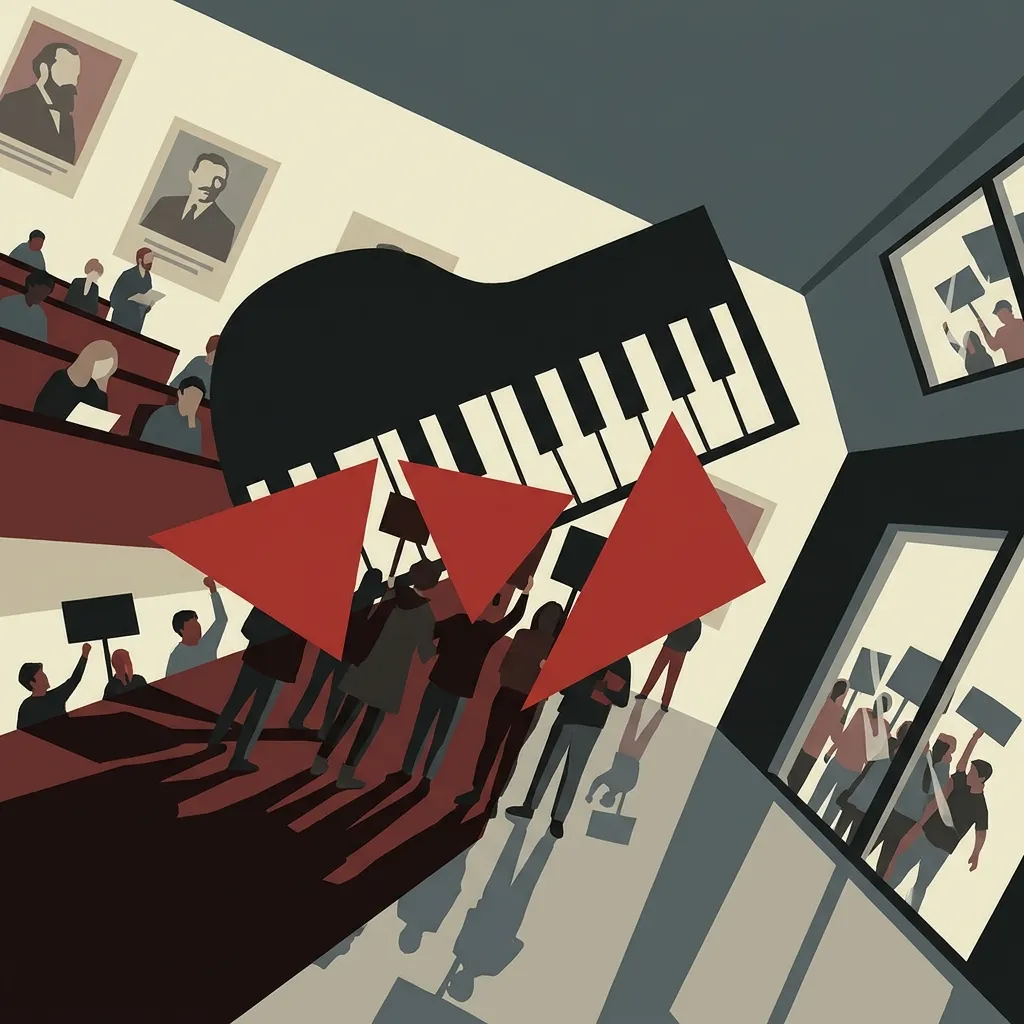
Whoever talks about music in communism is never just talking about sounds. It is always also about power, ideology, control, and the question of whom art is actually supposed to serve. Music provides a particularly clear way of demonstrating how political systems intervene in the private and the artistic. The repression of culture in Soviet communism was not a peripheral matter, but part of a comprehensive claim to power.
The reality is more complex than often appears in oversimplified accounts. Communism initially attracted many artists because it promised social justice, education for all, and the overcoming of bourgeois exclusivity. At the same time, a cultural hegemony of communism developed in which music was not supposed to be free, but rather useful, comprehensible, and ideologically reliable. Figures such as Zhdanov and Hanns Eisler therefore stand for very different yet closely connected sides of the same story.
This post shows how hope turned into control, why the accusation of ‘formalism’ was so effective, why Eisler must be read ambivalently to this day, and what we can learn from this history for the present. Anyone fundamentally interested in the intertwining of power and art will find at Resistance an important thinking space for this.
From Utopia to Doctrine: Why Music Became Political
Many composers and intellectuals initially felt drawn to communism not in spite of, but because of its social promises. The idea of liberating culture from elite spaces and making it accessible to a broad audience seemed modern and morally attractive. Yet this is precisely where the problem began: as soon as art was expected to be primarily socially useful, the political evaluation of aesthetic forms was not far behind.
A decisive turning point was 1932, when Socialist Realism was elevated to the official guiding doctrine. Musikgeschichte Online precisely summarizes this development, pointing out that this created a binding cultural-political direction (Music History Online). The Neue Musikzeitung also clearly describes this turning point:
The first important milestone in the relationship between the arts and the Soviet Union, founded in 1922, was the guideline of ‚socialist realism,‘ enacted in 1932 by the Central Committee of the CPSU as a directive for the fields of literature, fine arts, and music.
<DataTable headers={[“Metric”, “Value”, “Significance”]} rows={[[“Socialist Realism as guiding doctrine”,“1932”,“Binding cultural-political orientation”],[“Zhdanov campaign against ‘formalism’”,“1948”,“Central crackdown on modern music”],[“Zhdanov resolutions on cultural sectors”,“4”,“Literature, theater, film, and music 1946, 1948”]]} caption=“Historical key data on cultural policy in Soviet communism” source=“Musikgeschichte Online / Osteuropa” sourceUrl=“https://mugo.hfm-weimar.de/de/topics/formalismusdebatten” />
The table shows: It was not about individual single cases, but a structured system. Anyone who wants to view this development from a longer-term perspective will find in the interactive timeline: Music and Politics in the 20th Century – from 1918 to the present a helpful historical framework.
Zhdanov and the repression of culture in Soviet communism
When discussing the repression of culture in Soviet communism, there is no way around Andrei Zhdanov. He stands less for original thought than for the enforcement of political conformity in the cultural sphere. In the late 1940s, under his leadership, the already existing control was tightened once again. Especially 1948 became a symbolic year because the campaign against alleged ‘formalism’ publicly struck numerous composers.
The journal Osteuropa notes that Zhdanov drafted a total of four resolutions on various cultural sectors between 1946 and 1948 (Eastern EuropeThe term ‘formalism’ was intentionally vague. It could mean modern harmony, ambivalence, dissonance, intellectual complexity, or simply a lack of appeal. Precisely this fuzziness made it so politically useful.
According to an article on Musikgeschichte Online, the formalism debates served to aesthetically devalue and politically sanction modern or Western-influenced music (Music History Online). Step by step, this usually followed a similar pattern: first, a work or style was publicly criticized, followed by institutional measures, rituals of apology, and in the worst case, professional bans or existential threats.
This is precisely where the cultural hegemony of communism reveals itself in its hard form: not only content, but also forms had to subordinate themselves to the ideology. Music was supposed to be optimistic, close to the people, and accessible. Whatever was not compatible with this was not treated as an aesthetic alternative, but as a political problem.
Hanns Eisler: Convinced Socialist, Uncompromising Artist
Hanns Eisler is indispensable for any serious study because his biography prevents simple judgments. He was neither an outside victim nor a pure functionary from within. He was a politically convinced composer who believed in the social mission of music, yet at the same time collided with dogmatic cultural policy himself.
His understanding of music was explicitly social. A verified quote demonstrates this particularly clearly:
If music is for people, it must be respected and valued as a useful activity and not degraded to mere trifling or private amusement.
This sentence explains why Eisler remains fascinating to many leftists to this day. Music was not supposed to be a luxury, but a social practice. At the same time, precisely this demand carried a risk: if usefulness is defined politically, art loses its autonomy. Deutschlandfunk Kultur emphasizes that despite all contradictions, Eisler long believed in the socialist idea, even though the reality of state socialism increasingly troubled him (Deutschlandfunk Kultur).
His life path between Vienna, exile, the USA, and the GDR makes him a key figure of the 20th century. For teaching, Eisler is therefore particularly rich: idealism, political loyalty, and aesthetic self-assertion can all be discussed through him at the same time. A common mistake in teaching is to reduce him solely to the GDR anthem or solely to Brecht. Precisely his inner tension is historically revealing.
Music as a tool of rule: broadcasting, everyday life, and ideological control
Repression did not work solely through bans. Equally important was the active steering of what was heard, broadcast, and learned. Under state socialism, music was a medium for controlling everyday life. Broadcasting in particular played a key role in this because it could shape cultural preferences on a mass scale.
A particularly revealing document comes from a broadcasting conference dated October 25, 1950. There Gerhart Eisler formulated how openly political instrumentalization was intended:
The music we broadcast is not just a question of musical education. [...] We must know that we have to use backward music to bring progressive political content to the masses.
The relationship between art and power could hardly be formulated more clearly. Music does not appear here as an autonomous expression, but as a vehicle for political content. Contemporary historical research also shows that even popular forms like swing in state-socialist regimes hovered between 1945 and 1948/49 were partially tolerated before they were more harshly devalued as Western or imperialist (Studies in Contemporary History).
This is relevant, especially for today's debates about propaganda. Rule often works not only through censorship, but through curated availability.
Cultural Hegemony of Communism: Why the Repression of Culture in Soviet Communism Still Resonates Today
The cultural hegemony of communism consisted not only in direct suppression, but in shaping what was allowed to be considered legitimate art. That is what makes the subject so relevant to the present day. For even today, art is often judged not primarily by form, complexity, or openness, but by social utility, moral compatibility, or political unambiguousness.
Of course, democratic societies are not to be equated with the Soviet Union. Nevertheless, comparing the mechanisms is worthwhile. Wherever aesthetic ambiguity comes under pressure to justify itself, wherever art is only accepted as a message, and wherever institutions reward conformist readings, soft forms of cultural control emerge. Recent research and digital archival work therefore strengthen the culture of remembrance surrounding censorship and cultural policy in state socialism. Indications of this interdisciplinary research are provided, for example, by the Yearbook for Historical Communism Research and the Gerda Henkel Foundation (Yearbook for Historical Communism Research, Gerda Henkel Foundation).
This is a benefit for pedagogy and political education: music history thus becomes not a museum piece, but highly topical.
What we can learn from this today
Music in communism is more than a specialized topic for musicology or Eastern European studies. It is a cautionary tale about how quickly promises of liberation can turn into control when politics sets the aesthetic standard. The repression of culture in Soviet communism shows that interventions in art are rarely just matters of taste. They define who is allowed to speak, which feelings are legitimate, and which forms are considered suspicious.
Zhdanov stands for the bureaucratic violence of doctrine. Hanns Eisler stands for the tragic ambivalence of an artist who believed in the social power of music and yet experienced how that same idea could be turned against artistic freedom.
Anyone who wants to continue working with this should take three steps: first, think of historical sources and musical examples together; second, read terms like ‘formalism’ as political buzzwords; and third, make connections to the present carefully, but consciously. Platforms such as Resistance can help keep this connection of history, music, and political reflection alive. For anyone who hears how power interferes with music also better understands how societies struggle over themselves through art.
 Deutsch
 English
 Italiano
 Español