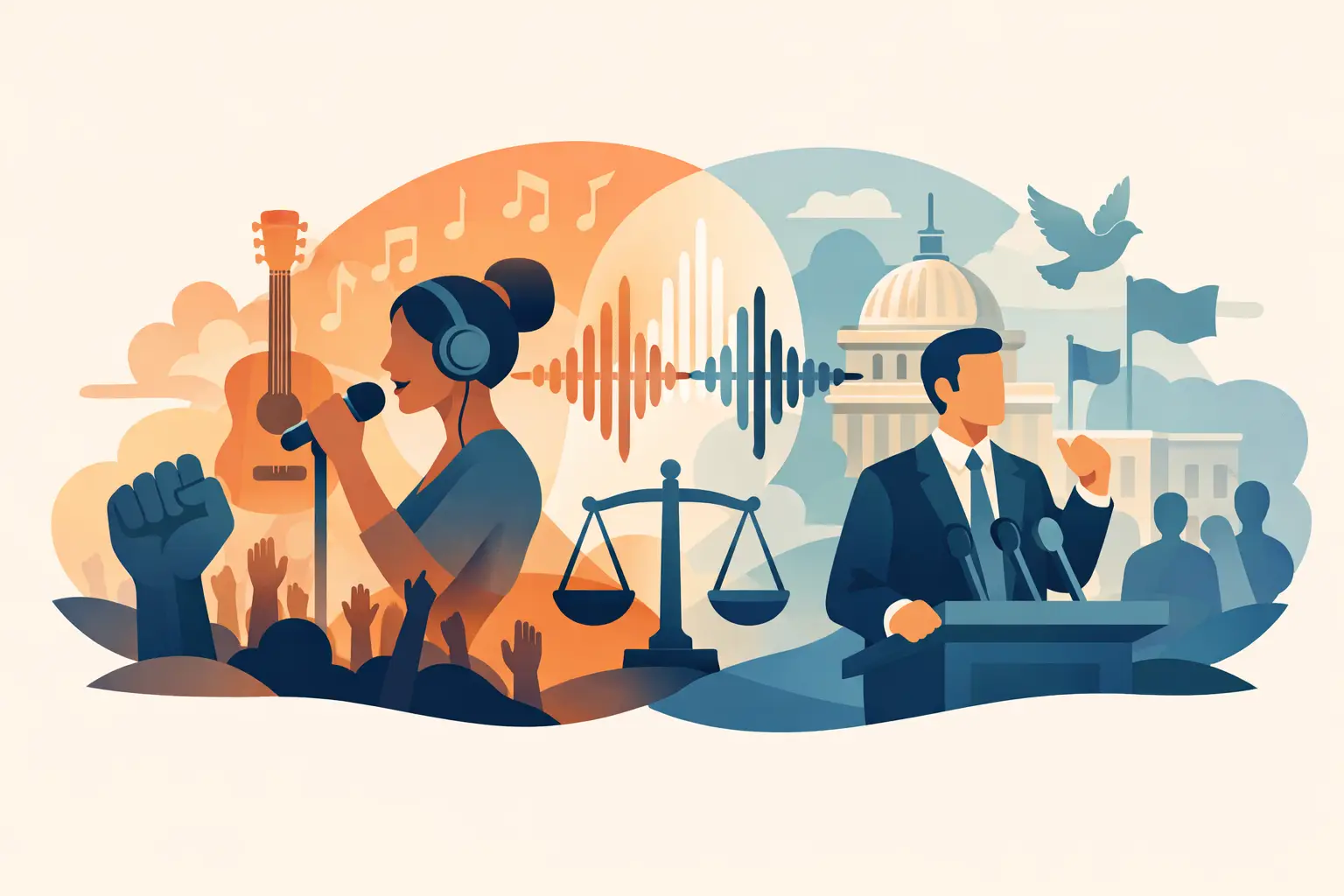
Anyone who reduces the connection between music and politics to mere protest songs misses the crucial point. Politics doesn't just reside in the lyrics of an anthem or the slogan of a song. It is embedded in performance venues, in funding structures, in censorship, in the question of who is heard, who is silenced, and what story a society wants to tell about itself.
Precisely for this reason, music is not suited to serve as a decorative background for history. It is part of its material. It organizes emotions, creates a sense of belonging, disciplines bodies, generates memory, and can make dissent audible even before it is articulated conceptually. Anyone who wants to understand how societies stabilize or change should not only look at parliaments, the media, and political parties, but also at sound.
## Music and politics in context
The connection between music and politics begins with a simple insight: music is never purely private. Even seemingly intimate listening is socially framed. Which music is taught in schools, which works are canonized in concert halls, and which genres are considered „high“ and which „merely popular“ are the result of cultural power struggles. Aesthetic judgments like to appear neutral, but they rarely are.
This applies to democratic societies just as much as to dictatorships, only with different means. Authoritarian systems often intervene openly – through bans, forced conformity, propaganda, and repression. Liberal democracies operate more subtly. Here, market logics, institutions, cultural sections, streaming algorithms, and funding pots help determine what gains visibility. That is less spectacular, but not apolitical.
Politics in music therefore does not mean only agitation. It also refers to the conditions of its production and reception. An orchestral program that ignores historical violence makes a political choice, even if it presents itself as apolitical. Likewise, a work that addresses war, exile, or persecution is not automatically politically effective. The decisive factor is how it is translated into the public sphere.
## Why music has a political impact
Music has a political effect because it occupies the space between thought and feeling. An editorial argues. A law mandates. Music does something different: it shapes moods, condenses experience, and makes ambivalence bearable or unbearable. Precisely therein lies its social power.
National anthems are the most obvious example. They create community not only through words, but through [ritualized repetition](https://polit-rhythms.blog/04/04/manipulation-durch-musik/2025/). Whoever sings along becomes part of a political body. Military music works similarly, only more directly. It synchronizes movement, strengthens discipline, and generates an affect of solidarity. This is not a minor detail, but the core of modern aesthetics of power.
Yet these same means can produce counter-power. Worker songs, spirituals, antifascist choirs, feminist punk scenes, or hip-hop from marginalized communities show that music becomes political even where people speak out against exclusion, violence, and degradation. Its strength often lies not in programmatic purity, but in shared experience. A song cannot replace complex conditions. But it can put people into a shared situation from which action becomes imaginable.
## Historical perspective sharpens judgment
Anyone who takes the connection between music and politics seriously must listen historically. Otherwise, one quickly confuses aesthetic surface with political meaning. A pathetic sound can express resistance or state cult. A dissonant composition can be read as emancipatory or as an elitist shield. It depends on context, origin, and use.
[The 20th century](https://polit-rhythms.blog/01/10/interaktive-timeline-musikgeschichte-politik-im-20-jahrhundert/2026/) provides rich material for this. Fascist and Stalinist systems both attempted [to use music for political purposes](https://polit-rhythms.blog/06/03/musik-und-musikleben-im-nationalsozialismus/2025/), albeit in different ways. The blacklisting, exile, and murder of artists were part of this, as was the promotion of approved aesthetics. At the same time, music emerged in exile, underground, and on the margins that asserted memory against oblivion.
After 1945, the question continued, just under different auspices. In Western Europe and the USA, artistic freedom was often declared a sign of liberal superiority. That was historically understandable, but not free from instrumentalization. Avant-garde art, too, could be integrated into geopolitical narratives. It does not follow from this that every art is merely a tool. It only means that autonomy always remains contested.
## Between propaganda and resistance
The most comforting narrative goes: here is free art, there is propaganda. It is not that simple. Music can resist state co-optation and at the same time produce exclusions of its own. It can be on the right side morally and remain aesthetically inconsequential. It can provide comfort in dark times and yet neutralize politically if it functions merely as a substitute action.
Resistance music is not inherently resistant just because it calls itself that. Sometimes it merely validates its own scene. Conversely, a seemingly difficult work can be highly politically relevant if it takes historical experience seriously and refuses the language of trivialization. Contemporary classical music in particular is often misunderstood in this regard. Many view its degree of abstraction as a detachment from the world. In fact, abstraction can be a precise form of perception—especially where what can be said directly has become worn out, ideologically loaded, or morally too smooth.
For a project like Resistenza, this is precisely where the intervention lies: not treating music as an elitist special zone, but as a medium of historical and political understanding. This requires translation, not simplification. It demands images, texts, conversations, and context so that complex sonic languages can become publicly effective.
## Who is allowed to speak, who is heard?
Every political perspective on music must also question institutions. Canons do not fall from the sky. They are made—through opera houses, universities, arts and culture sections, foundations, labels, and nowadays also platforms. These authorities help decide which voices are considered representative and which disappear into niches.
That is why representation is not a trendy side issue. When certain social groups, backgrounds, or political experiences are structurally underrepresented, it is not just the institution that is impoverished. The societal listening space also narrows. This concerns gender, class, ethnicity, and geographical perspective alike.
However, moral accounting alone is not enough. More visibility is necessary, but it does not replace aesthetic engagement. The decisive factor is whether institutions are willing to change their routines—meaning not just putting different names on the same programs, but also taking different modes of storytelling, different themes, and different audiences seriously.
## The Present: Algorithm, Attention, Affect
Today, the connection between music and politics is shifting once again. It is no longer just states and cultural institutions that shape the acoustic space, but platforms. What gets attention is increasingly organized by measurability. Shorter formats, faster recognizability, permanent availability—all of this changes how music is heard and evaluated.
This development does not automatically have to be read as cultural pessimism. Digital spaces can create counter-publics, make archives accessible, and amplify marginalized voices. At the same time, they promote superficial stimuli, outrage loops, and the breakdown of works into monetizable snippets. For politically ambitious art, this is a real problem. Because it often thrives on duration, context, and concentration—conditions that the attention economy systematically puts under pressure.
Right here, mediation is needed as cultural work in the truest sense. Not as marketing cosmetics, but as a public translation service. When music negotiates historical violence, war, displacement, or authoritarian temptations, there must be a discussion about how it does so and why this form was chosen. Otherwise, even the serious work gets lost in the noise of content.
## What are the implications of this for listeners?
To listen politically does not mean reducing every piece to a slogan. It means asking more precise questions. Who wrote this work and under what conditions? In what historical moment does it stand? What community does it imagine, what experience does it condense, what conflicts does it ignore? And equally important: how is it performed, framed, and understood today?
Such listening requires patience. It runs counter to the reflex of using music either as mere entertainment or as a moral badge. The reward lies in a more precise perception. One then hears not only melodies and forms, but also power relations, struggles over memory, and possibilities of dissent.
Perhaps that is the actual political task of music: not to provide ready-made answers, but to defend perception against numbing. In times when language is becoming brutalized, history is being shortened, and the public sphere is accelerating, that is anything but little. Whoever listens in this way is not just consuming culture. They are practicing judgment.
 Deutsch
  English
  Italiano
  Español