
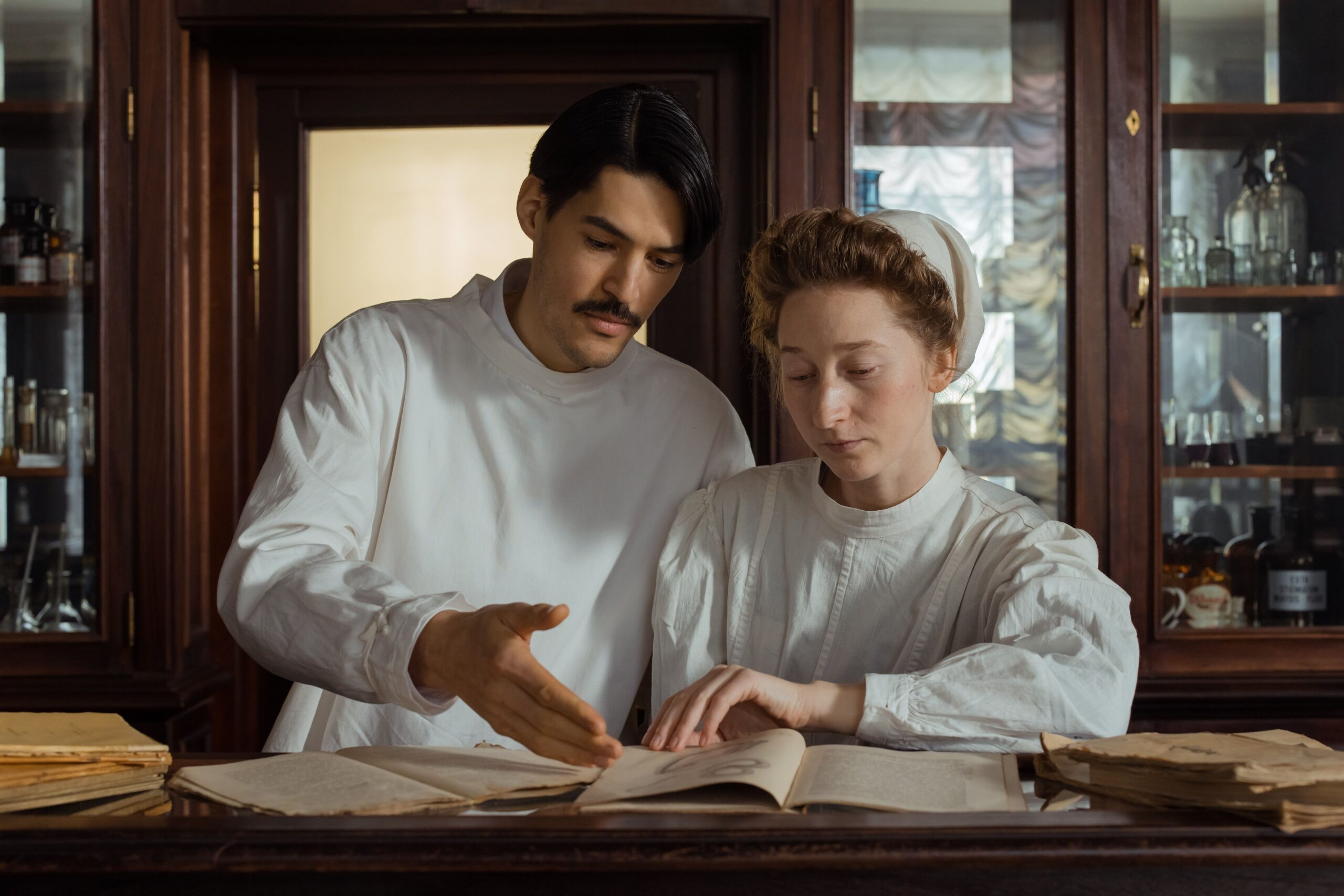
Looking back at the history of medicine, one quickly feels superior. Episode 41 of Schallwelten therefore begins with a warning against the comfortable narrative of the „dark ages.“ Episode 42 is expected to continue the topic on September 14, 2026:
„Knowledge is always the current state—not the truth forever. Science is a continuous process.“
– Katrin
People explained illness with the knowledge and capabilities of their time – just as we do today.
Medieval medicine: more than superstition
In European the Middle Ages, there was scholarly medicine. Monasteries were places of transmission and care; alongside them, physicians, surgeons, midwives, and bathhouse keepers practiced. The humoral pathology of the Hippocratic Corpus, later systematized by Galen, shaped the mindset. Translations of Arabic-language works enriched the Latin West; Salerno became a center of medical education.
Much of the rural population hardly reached this knowledge. There, folk medicine combined practical experience with religious and magical beliefs. An Old High German worm charm personifies the affliction and commands it:
„Go out, worm, with your nine worm children. Out of the marrow into the bone, out of the bone into the flesh, out of the flesh into the skin, out of the skin. Lord, so be it!“
The worm blessing is not with the Merseburg Incantations to be equated with. However, their reworking by In Extremo subsequently builds a musical bridge: circular repetitions make modern rock music appear ritualistic and almost timeless.
Magic and Christianity were not neatly separated worlds. Many formulas contain Christ, saints, or prayers; pagan-Germanic elements are rare, as in the second Merseburg charm. Above all, rituals promised the ability to take action again in times of illness and uncertainty.
When observation became more important than authority
During the Renaissance and the Early Modern Period, the standard of knowledge shifted:
„This is now slowly but unstoppably being replaced by one's own observation – empiricism.“
- Ralf
Human dissections were not generally forbidden in the Middle Ages, but remained rare and regionally limited. Andreas Vesalius stated in 1543 On the Fabric of the Human Body one's own anatomical observation against certain traditional teachings. Around 1508/09, Leonardo da Vinci used molten wax to make a Cast of the brain ventricles of an ox Thus, experimental observation began to correct older ideas.
Paracelsus attacked dogmas, Francis Bacon emphasized experience and experiment, René Descartes methodical doubt. William Harvey showed that blood circulates in a loop. Progress, however, was never straightforward: Franz Anton Mesmer postulated an „animal magnetism.“ Mozart used it in All Women Do That Comedy, when Despina as a disguised doctor „heals“ the supposedly poisoned ones with magnetic means.
The body becomes audible and visible
Microscope and stethoscope expanded the doctor's senses. Robert Hooke saw in cork those small chambers that he called „cells“; Antonie van Leeuwenhoek observed various microorganisms, his „diertgens“. In 1816, René Laennec developed the initially monaural stethoscope. The Paris School increasingly combined bedside findings with autopsies.
In the 19th century, Vienna became one of the major centers of this new medicine. Carl von Rokitansky systematized clinical-pathological correlation, while Rudolf Virchow placed cellular changes at the center. Pasteur and Koch strengthened the germ theory, and Lister further developed antiseptic surgery.
„Names like Rokitansky, Virchow, Pasteur, Koch, and Lister were the heroes of my youth, alongside Beethoven, Mozart, and Schubert.“
– Alfred
Beethoven's „Holy Song of Thanksgiving of a Convalescent to the Deity“ from the String Quartet in A minor, Op. 132, is a reminder that recovery continues religiously interpreted could be.
Why the Magic Doesn't Disappear
Even modern medicine does not eliminate uncertainty. Freud searched for invisible causes of psychological symptoms. Britten's Death in Venice makes illness, obsession, and loss of control audible. Alban Berg's Wozzeck on the other hand, shows the dark side of medical authority: a human being is turned into an experimental subject and morally degraded.
„Unfortunately, or thank God, medicine still has something magical about it, specifically in the area of doctor-patient contact.“
– Alfred
Hope, expectation, and attention can influence symptoms and subjective experience. However, it does not follow from this that pseudomedical explanations become true:
„The system cannot fail at all. If it works, it was the magic. If it doesn't work, you didn't believe hard enough or you did something wrong.“
– Katrin
Double-blind studies are intended to reduce expectation and observer biases – not „turn off“ hope.
„So the difference from the Middle Ages is not that we have become smarter. The difference is that people back then had no choice. But we do!“
– Katrin
What remains?
From worm blessing to double-blind trial, there is no simple success story leading from error to definitive truth. Progress is an attitude: observing, testing, providing transparent reasoning, doubting, and correcting. Science is allowed to err. But it must be designed in such a way that it can recognize its own errors.
The music in episode 41 and the preview of episode 42
- In Extremo „Merseburg Magic Spells – the modern musical approach to an ancient ritual.
- Wolfgang Amadeus Mozart All Women Do That Mesmer's magnetism becomes an opera comedy.
- Ludwig van Beethoven: String Quartet in A minor, Op. 132 – Convalescence between new strength and gratitude to the Deity.
- Benjamin Britten: Death in Venice - Illness, obsession, and an increasing loss of control.
- Alban Berg: Wozzeck – medical authority and the human being as a test subject.
Episode 41 has already been released. Episode 42 is expected to be released on September 14, 2026; we will add the direct link after publication.
Alfred Huber: Medizin und Musik
Alfred Huber ist Neurochirurg und Komponist. Mehr über seinen ärztlichen Werdegang erfahren Sie auf der persönlichen Vorstellungsseite seiner Praxis in Kempten. Seinen Werkkatalog and Hörbeispiele finden Sie auf alfredhuber.eu.
 Deutsch
 English
 Italiano
 Español